

Dental Bridges Tacoma vs Dental Implants — What Nobody Tells You
You have a missing tooth. Your dentist mentions two options — a dental implant or a dental bridge.
Both replace the tooth. Both restore your smile. So what is the real difference — and why does it matter so much which one you choose?
At Davis Dental Group, we have this conversation with patients every week. And what we find is that most people walk in knowing very little about how these two options actually compare — not just in cost, but in how they affect the rest of your mouth for years to come.
This guide gives you the full picture. No oversimplification, no pressure. Just honest information so you can make the right decision for your smile, your jaw, and your long-term oral health.
Dental Bridges Tacoma: Understanding the Basics of Each Option
Before comparing the two, it helps to understand exactly what each treatment involves.
What Is a Dental Bridge?
A tacoma dental bridge is a fixed restoration that literally bridges the gap left by a missing tooth.
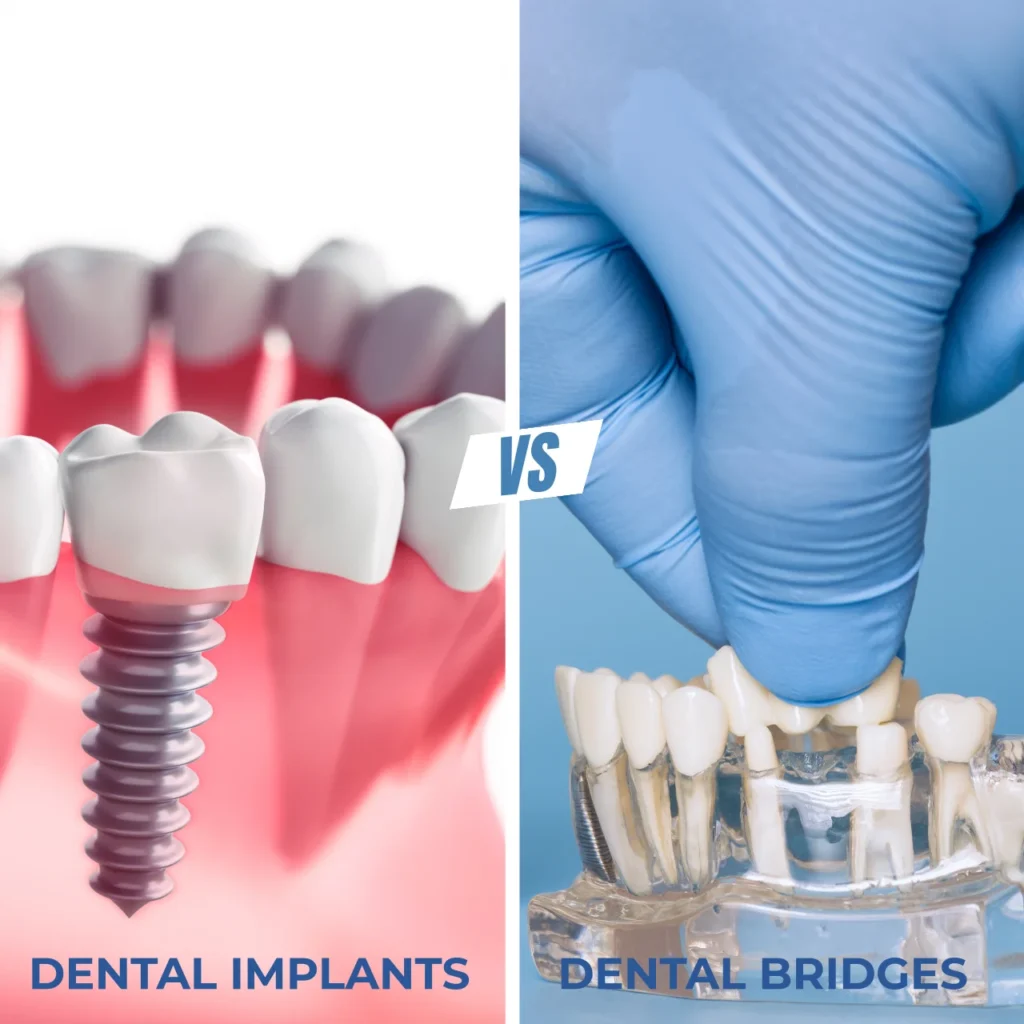
It works by anchoring to the two healthy teeth on either side of the gap — called abutment teeth. These neighboring teeth are filed down and fitted with dental crowns in Tacoma to serve as anchors. A false tooth — called a pontic — is then suspended between them, filling the empty space.
The result is a seamless-looking row of teeth. The bridge is cemented in place and not removable by the patient.
What most patients are not told upfront:
To place a bridge, your dentist must permanently alter two perfectly healthy teeth. Enamel that is removed never grows back. Those teeth will always need crowns — for life — whether or not the bridge is eventually replaced.
What Is a Single Tooth Implant?
A single tooth implant in Tacoma is a titanium post placed directly into the jawbone where the missing tooth root used to be. Once it fuses with the bone — a process called osseointegration — a custom porcelain crown is attached on top.
The implant stands completely on its own. It does not touch, rely on, or alter any neighboring teeth whatsoever.
This is the key distinction most patients wish they had understood earlier.
Dental Bridges Tacoma: What the Comparison Really Looks Like
Here is where the conversation gets important — and where most patients feel they were not given the full picture.
How Do They Compare Long Term?
Bone Health
This is the biggest difference — and the one that affects your face and jaw for decades.
When a tooth is lost, the jawbone beneath it no longer receives stimulation. Without that stimulation, the bone begins to shrink. A dental bridge replaces the visible tooth but does nothing to stop this process. The bone beneath the pontic continues to resorb year after year.
A dental implant, on the other hand, acts as a tooth root. Every time you bite down, it stimulates the jawbone — preserving bone volume and maintaining the natural shape of your face. This is the only tooth replacement option that actively prevents bone loss.
Over 10 to 20 years, patients with bridges often notice a gradual sunken appearance around the gap — the result of ongoing bone loss beneath the bridge. Implant patients typically do not experience this.
Neighboring Teeth
A bridge requires permanently grinding down healthy adjacent teeth. Over time those prepared teeth can become more vulnerable to decay, fracture, and nerve sensitivity — especially where the crown margins meet the gumline.
An implant leaves every neighboring tooth completely untouched. This is a significant long-term advantage that is easy to overlook when focused on the immediate cost difference.
Lifespan
Dental bridges typically last 5 to 15 years before they need replacement. When a bridge fails, it often means new crowns on the abutment teeth, a new bridge, or transitioning to an implant anyway — frequently at a higher total cost than if the implant had been placed initially.
According to the American Academy of Implant Dentistry, dental implants have a clinical success rate of over 95% — and with proper care, can last a lifetime. The crown on top may need replacement after 15 or more years, but the implant post itself is permanent.
Cost
Bridges have a lower upfront cost — and for some patients that is a genuine deciding factor. We understand that, and we will never minimize it.
But when you factor in the eventual replacement of the bridge, the ongoing treatment needs of the altered abutment teeth, and the cost of addressing bone loss that a bridge does not prevent — the long-term financial picture often favors implants.
We offer flexible financing options to help make implants accessible for more patients across Tacoma, Spanaway, Parkland, Eatonville, Frederickson, Graham, Roy, and JBLM.
Tacoma Dental Bridge: When Is a Bridge Still the Right Choice?
A bridge is not always the wrong answer. There are situations where it genuinely makes more sense.
A bridge may be better when:
- The adjacent teeth already need crowns for other reasons — in which case the bridge is a natural fit
- Bone loss or health conditions make implant placement too complex
- A faster timeline is needed — bridges are typically completed in two to three weeks, while implants require several months
- Budget constraints make the upfront difference a deciding factor
At Davis Dental Group we will always give you our honest recommendation based on your specific situation — not a one-size-fits-all answer. Sometimes a bridge is genuinely the right call. What matters is that you understand the trade-offs before you decide.
Questions to Ask Before You Choose
Before committing to either option, here are the questions worth asking your dentist:
- Are my neighboring teeth healthy? If yes — an implant protects them. A bridge permanently alters them.
- How is my bone density? Good bone density makes implant placement straightforward.
- What is my long-term plan for this smile? If longevity matters most, implants almost always win.
- What does my timeline look like? If you need a fast solution, a bridge delivers quicker results.
- What financing options are available? Ask about monthly payment plans before ruling out implants on cost alone.
At Davis Dental Group, every patient consultation includes a thorough exam, digital X-rays, and an honest conversation about all your options — with no pressure and no upselling.
We also offer a full range of cosmetic dental services and restorative dental care to complement your implant or bridge with a smile that looks and feels its best.
The Bottom Line
A missing tooth deserves more than a quick fix. It deserves a solution that protects your jawbone, preserves your neighboring teeth, and serves you for decades — not just years.
For most patients who qualify, a single tooth implant in Tacoma is the most complete, longest-lasting, and bone-preserving solution available. A dental bridge in Tacoma remains a strong option in the right circumstances — but it comes with trade-offs that every patient deserves to understand before signing on.
The best decision is an informed one. And we are here to help you make it.
Schedule your consultation with Davis Dental Group today or call us at (253) 537-9317. Our team serves families across Tacoma, South Tacoma, Spanaway, Parkland, Eatonville, Frederickson, Graham, Roy, and JBLM — and we are ready to help your smile.
FAQS
Q: What is the main difference between a dental implant and a dental bridge?
A: A dental implant replaces both the tooth root and the visible crown — independently, without affecting neighboring teeth. A dental bridge in Tacoma anchors to adjacent teeth by filing them down and placing dental crowns in Tacoma on them. Implants also prevent bone loss beneath the gap; bridges do not.
Q: How long does a dental bridge last compared to an implant?
A: Dental bridges typically last 5 to 15 years before needing replacement. A single tooth implant in Tacoma, with proper care, can last a lifetime. The long-term cost of implants is often lower despite the higher upfront investment.
Q: Is getting a dental implant painful?
A: Most patients are surprised by how manageable the procedure is. It is performed under local anesthetic, and recovery is often compared to a tooth extraction. Any discomfort typically resolves within a few days.
Q: Do both bridges and implants use dental crowns?
A: Yes. Dental crowns in Tacoma are used in both treatments. In a bridge, crowns are placed on the adjacent teeth to anchor the restoration. In an implant, a single crown sits on top of the implant post. The difference is what supports it — an implant fused to your jawbone versus filed-down healthy teeth.